How do you find out how old a roof is?
Last updated:
The most reliable way to date a roof is the building permit filed when it was last replaced. Most U.S. jurisdictions require a permit for a re-roof, and the permit's issue or final-inspection date is the roof's age. If no permit exists, insurance inspection reports, seller disclosures, and shingle condition are the fallbacks — in that order.
The five ways to date a roof, ranked
The order carries information: each method is less certain than the one above it.
- Re-roof permit on file — Exact date. Filed by the roofer with the city or county; includes contractor name, scope, and often the material. Coverage varies: some counties record nearly every re-roof, others almost none.
- Insurance or 4-point inspection report — Usually within 1–2 years. Florida 4-point and wind-mitigation inspections state roof age directly; other states' insurer inspections often do.
- Seller's disclosure or closing documents — As accurate as the seller's memory. Look for “roof replaced” with a year on the disclosure form.
- Manufacturer or contractor warranty paperwork — Exact if the homeowner kept it. Ask.
- Visual condition — ±5 years at best. Granule loss, curling, cracked or missing shingles, moss, exposed nail heads. Useful for a sales conversation, not for an insurance form.
How to look up a roof's age by address
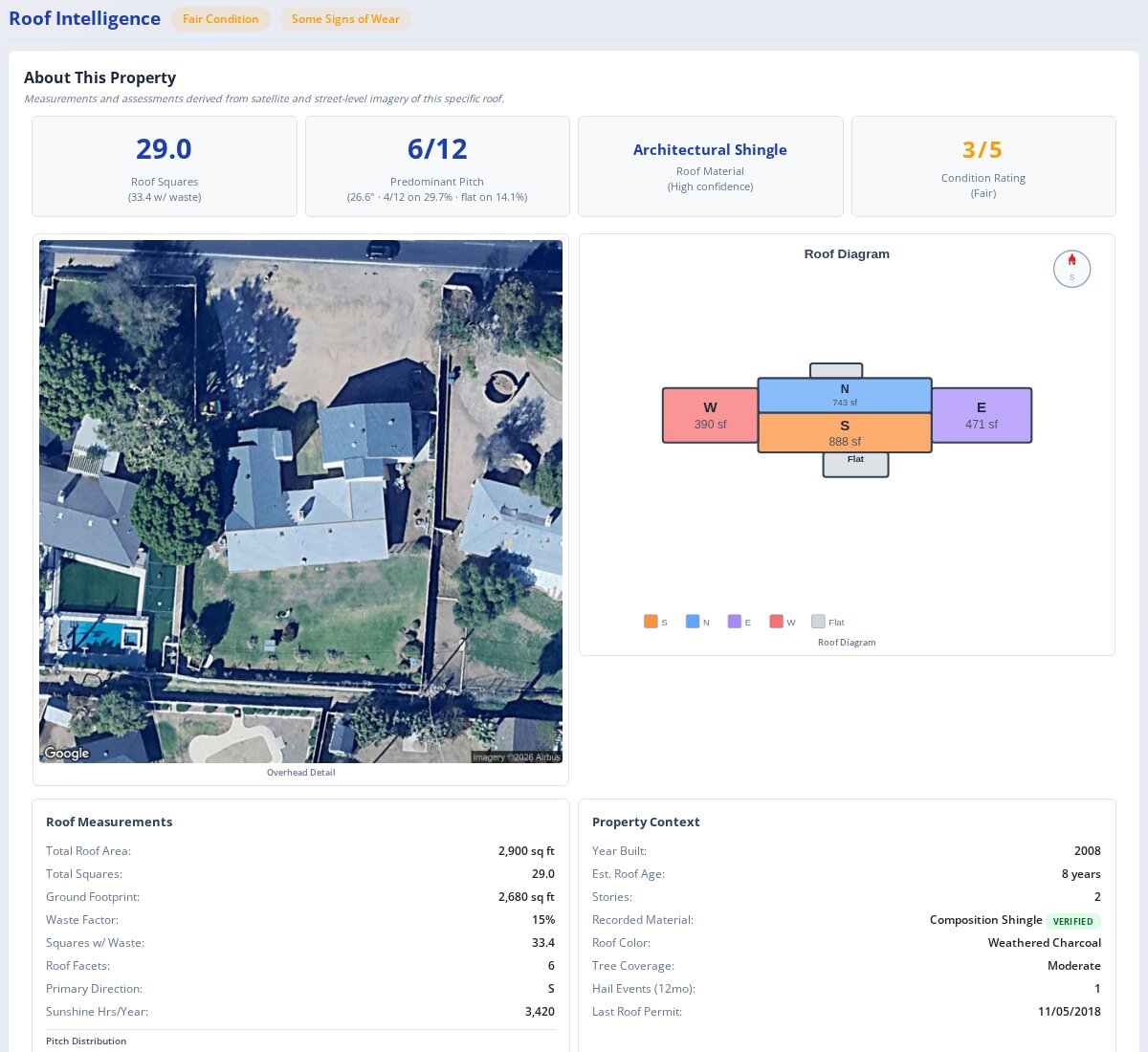
Permits are public records. You can search the city or county building department portal for the address and filter for “roof” or “re-roof”. The catch is that every jurisdiction runs a different portal and many older permits are paper only. ServiceCall's property reports pull 400M+ historical permits into one lookup, so a roofing or HVAC contractor can see the re-roof date, the contractor who did it, and the HVAC and water-heater permits on the same house before the appointment.
Why roof age matters to insurers (and to the homeowner you're quoting)
Many carriers won't write or renew a policy on an older asphalt roof, or switch it to actual-cash-value coverage. That's why “how to determine age of roof for insurance” is one of the most common searches on this topic. A documented replacement date — a permit — is what the carrier wants; a contractor's estimate usually isn't enough.
Average roof age by material
| Material | Typical lifespan | Replace-window insurers watch |
|---|---|---|
| 3-tab asphalt shingle | 15–20 yrs | ~15 |
| Architectural asphalt | 25–30 yrs | ~20 |
| Metal (standing seam) | 40–70 yrs | rarely |
| Tile (clay/concrete) | 50+ yrs | rarely; underlayment ~20–25 |
| Wood shake | 20–30 yrs | ~20 |
| Flat / modified bitumen | 15–25 yrs | ~15 |
Signs a roof is near the end of its life
Most asphalt roofs announce the last third of their life from the ground and from the gutters. None of these signs date a roof on their own, but two or more together usually mean the replacement conversation is close.
- Granule loss in the gutters
- Curling or cupping shingles
- Cracked or missing shingles
- Dark streaks or moss
- Daylight through the roof boards
- More than one layer of shingles
For contractors: finding every home in your territory with an aging roof
Permit history plus year built lets you filter a territory to homes whose last re-roof (or original roof) is 15+ years old, then layer hail history and owner tenure on top. A home built in 2004 with no re-roof permit on file is a 22-year-old roof; a home built in 1991 with a re-roof permit in 2015 is an 11-year-old roof and comes off the list. That arithmetic runs across every parcel in a ZIP code at once.
That is what ServiceCall Prospector does — a list you build and own, not leads someone else sells to you. Draw the territory, set the roof-age filter, add the hail and tenure layers, and export it to mail, a dialer, or your CRM. The step-by-step guide to generating your own roofing leads walks through the whole build.
Frequently asked questions
How can I find out how old my roof is?
Check for a re-roof permit at your city or county building department, then your home inspection or insurance inspection report, then the seller's disclosure from when you bought the house.
How do I determine the age of my roof for insurance?
Insurers want a documented replacement date. A re-roof permit or a contractor invoice with a date is accepted; a visual estimate usually isn't. A licensed roof inspection report is the next best option.
Is there a roof age lookup by address?
Yes — permits are public records, and ServiceCall property reports consolidate 400M+ historical permits so a contractor can see the re-roof date for any address in seconds.
What is the average age of a roof?
Asphalt roofs last 15–30 years depending on shingle type; metal and tile roofs last 40 years or more. Most U.S. roofs being replaced today are 20–25 years old.
Does homeowners insurance cover roof replacement due to age?
No. Insurance covers sudden damage (wind, hail, fallen tree), not wear. Older roofs are often moved to actual-cash-value coverage, which pays a depreciated amount.
Can you tell roof age from the shingles?
Roughly. Granule loss, curling, and cracking show up in the last third of a roof's life, but condition varies with climate and installation quality, so treat it as ±5 years.